Posts

Showing posts with the label personal fabrication

Designing for the future of Make-On-Demand

Image
2 years ago I wrote about how industrial design will be affected by personal fabrication or desktop manufacturing.   The prediction was that due to the advancement of rapid prototyping technology that products will be manufactured in your own community  and perhaps in your own home with desktop manufacturing machines.   This is an exciting idea because it revolutionizes the traditional product development process,  which is full of waste, management overhead, shipping containers, distribution, and over production.   And it's beginning to happen today, although in a different format than expected.   Web-based companies such as Ponoko , Zazzle, CafePress , Blurb, Lulu are making this a reality.   You design something, upload it, and they display it, sell it, make it on demand, and ship it to the customer.  And you get paid for each sale.   The material limitations that we see now are really just temporary and it's only a matter of time before a company with a FDM machine and a ...
Safari at Murchison

August 30th, 2007 The safari was incredible, we'll try to send some pictures tonight. We saw elephants, giraffe, warthogs, baboons, boks, and the most rare and amazing of all, we were 15 feet from two lions! The ranger found them with some binoculars and we drove right up to them (with the windows closed of course). They were lying in the shade, resting after their breakfast. We also saw a hippo. The video and pictures that we got were great. What wasn't great was the 3.5 hour drive on rutted dirt roads just to get there. I never thought that I would day-dream about smooth fast highways, but I do now. I'm being picked up soon to visit one of the Bodas families. We had our training session this morning and gave out the toolboxes. They were so excited that they called the local reporter to come right away and see and write a story for the radio.

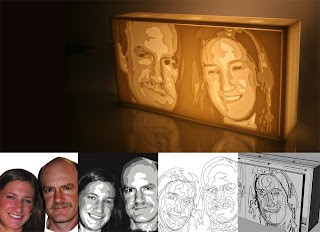
Personal Fabrication Concepts: Illuminated Photobox

Image
Sarah Owen's Illuminated Photobox Sarah’s display begins with a digital photograph. This photograph is transformed into a topographical relief surface. The brightest portions of the photo are the thinnest section and the darkest areas are the thickest sections. This 3D data is converted into surfaces and fabricated using an FDM machine. When light is transmitted through the semi-translucent display the photograph appears as areas of dark and light. Every display can be unique, depending on the photo. Her final FDM part is about 8 inches wide.

Personal Fabrication Concepts: 3D graffiti

Image
Yale Wolf's Three Dimensional Graffiti: From the head, to the spray can, to the wall, to digital photo, to traced outlines, to 3D surfaces, to STL file, to FDM part. His final part is about 12 inches long, limited by the working envelope of the machine. Have a 3D printer, SLA, or FDM machine? You can fabricate Yale's design for yourself. The STL file is available to download here. It can be viewed in most 3D software packages, such as Rhinoceros or Solidworks.

Personal Fabrication Concepts: Perfume Atomizer

Image
Molly Purdin’s Remix Perfume Atomizer Molly’s perfume atomizer “Remix” combines a vintage atomizer, which was found at an antiques shop, with a “bottle” inspired by a standard transmission. Her original concepts were very flowery and organic, but they didn’t reflect Molly’s personal concept of femininity. She chose to emphasize her affinity with tools and manual transmissions. Have a 3D printer, SLA, or FDM machine? You can fabricate Molly's design for yourself. The STL file is available to download here. It can be viewed in most 3D software packages, such as Rhinoceros or Solidworks.

Personal Fabrication: part 4... the Potential

Image
The Potential of 3D Printing for Industrial Design FDM Perfume bottle by Molly Purdin 2007. Re-mixed industrial design Just as musicians can upload tracks of their music files for the public to download and re-mix, the same could happen for industrial design. In fact it already happens today in the form of modifications to cars. Users buy variations of wheels, bumpers, lights, and other car parts to suit their own style. A future example might be a software program from Motorola that allows one to create a unique mobile phone design. It could provide options for shape, configuration, button layout, size, graphics and color. These options would be displayed as three-dimensional rendering on-screen before one decides to press “print.” FDM Lamp with personal soundwave topology by Michele Kiss Open-source Industrial Design Open-source software, such as the Firefox browser, is being constantly revised and updated by various software coders around the world. These changes a...

Personal Fabrication: part 3.. The Disadvantages

Image
The Disadvantages of Personal Fabrication 3D printed graffiti piece by Yale Wolf Abuse What if people use desktop manufacturing to make weapons or products to hurt others? As with any tool, it could be used for malevolent purposes. This capability, combined with the ease of internet file transfer could mean the simple creation of destructive devices. Intellectual property protection problems How does this affect patent protection when a design could be easily copied just as a music file can be copied today? Does it devalue the work of the designer? How can 3D data files be protected, or only allowed to be fabricated a limited number of times? Here is where coordination with software developers and programmers will be necessary. Cost Part cost is much higher than a mass-produced part, so the value of the part must be justified. This is not a process for everyday commodity objects. It only is feasible for applications that utilize its inherent advantages. This gap...

Personal Fabrication: part 2...The Advantages

Image
What are the advantages to using desktop manufacturing as a production process? No tooling costs or lead-time Once a design is complete as 3D digital data, it’s ready to be produced. There are no enormous tooling costs of several thousand dollars, and no tooling lead-times of several months. Just upload it to a rapid prototyping service on the Internet, and get it back in a couple of days. On-demand manufacturing This method could completely re-order the sequence of product development and manufacturing. Now one can design it, sell it, and then make it. The common method of product development is to mass manufacture a product and then try to sell them. But if there are no tooling-costs to absorb and each product can be quickly made one at a time, one only then needs to make just enough to satisfy demand. This means less waste, less overstock, and less overproduction. The end of marketing as we know it Marketing is based on the goal of understanding the customer so that only th...

Personal Fabrication and the Future of Industrial Design: Part 1

Image
Here's a preview of a paper that I'm working on right now... (note: I have since finished two versions of this paper and it was published in the ICSID/IDSA International Education Conference Proceedings 2007 and the book Shaping the Future? The 9th International Conference on Engineering and Product Design Education.  You can read the finished paper PDF here. ) A revolution in manufacturing may be coming sooner than we expect, and it could change industrial design dramatically . Eventually, it is predicted one will be able to fabricate a product in the home, just as one can print out a color document today. It’s called personal fabrication1 or desktop manufacturing. How will this affect the profession of industrial design? Does it empower industrial designers or does it make every person a designer? With the creative insights of design students, this paper explores the possibilities and implications of this coming paradigm shift. What is personal fabrication? Rap...