Posts

Showing posts with the label Uganda

Hoima Bicycle Documentary on IMDB

Image
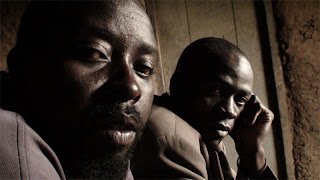
Hoima Bicycle is listed on IMDB (Internet Movie Database) and if you've seen it, please consider giving it a rating.  It needs 5 user ratings to be given a number.  (You can be honest, it was my first documentary.)  If you haven't, it's posted on Youtube in 4 parts... This documentary shows the process of designing a bicycle for and with Ugandan bicycle couriers, known as Boda-boda. Filmed primarily in Uganda, it shows the realities of current day East Africa, from the chaotic streets of Kampala to the inside of gritty mud-thatched homes in rural Hoima. In Uganda many residents use cheap, clunky bicycles for their primary means of transportation. Through a unique collaboration between an American designer and Ugandan couriers, a new bicycle design was conceived and a prototype was made. The designer then traveled to Uganda to meet the couriers and to have the bike tested and critiqued. Would they like it? Or is it back to the drawing board? How can you use you...
Kony is Very Real

Image
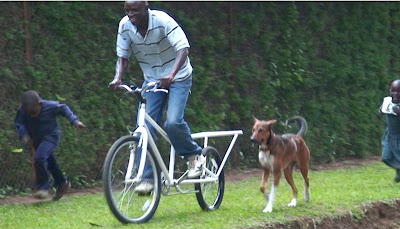
Patrick (on bike) with his daughter (right) and neighborhood friend (left), escaped from Kony's, LRA. In 2007 when I visited Hoima, Uganda to work with the local bicycle couriers on a new bicycle design, I met a young man, Patrick.  He worked for my mother as a handyman and groundskeeper and lived in a small home with his daughter, but he was not a local to Hoima.  He had escaped his hometown in Northern Uganda with his what was left of his family to Hoima.  He told us the story of the horror of Joseph Kony's Lord's Resistance Army and how some of his family and friends had been murdered.  So he escaped with his daughter and fled as far south as he could travel before settling in Hoima.  Mark Hardin did a video interview with him, which I still have but haven't edited.  Having heard his eye witness account myself, this LRA and their leader Joseph Kony is very real.  However, you don't need to buy a kit of stickers and posters.  I've lost touch...

Hoima Bicycle Documentary out on DVD

Image
My documentary about design for the other 90%, Hoima Bicycle , was just released on DVD on Amazon.com.   It shows the process of designing a bicycle for and with Ugandan bicycle couriers, known as Boda-boda. Filmed primarily in Uganda, it shows the realities of current day East Africa, from the chaotic streets of Kampala to the inside of gritty mud-thatched homes in rural Hoima. The intent was that it could be used in the classroom as a point of discussion about designing for social impact.  The project had it's successes and it's shortcomings, but many lessons can be drawn from it.  Especially a look at the culture of modern day East Africa for those who might want to do work there.It's only 30 minutes long and I'll be posting a list of discussion questions here and on the WWU ID site. I'll be presenting on the project at the National Collegiate Inventors and Innovators Alliance (NCIIA) annual conference "Open" in San Francisco on March 26th, 2010.

Hoima Bicycle (part 2 of 4)

Here's the next segment of Hoima Bicycle.  An imperfect example of design for social impact. 

Design for Social Purpose: an Alternative way to Give a Damn

Image
Above: mud thatched home for a family of seven in Uganda. Below: designer bedroom for one child in Paris. (lower photo from Dwell) How can an industrial designer make an impact on the poor of the world?  We might have some creative skills, we can visually communicate, and we can find unconventional ways of solving problems.  And one way is to immerse oneself into a different socio-economic culture, experience the problems to be addressed and work on designing a solution.  This is one obvious way, and it can be an incredible experience and make a real difference.  However, we can’t all do it, and sometimes flying to Africa and trying to make some helpful gadget has limited long-term sustainable impact.  Perhaps, instead of airfare half-way around the world, that money could go to supporting an orphan’s care?  Or building a well for a village, or a family’s medical care, or a child’s education?   These are very immediate needs for mo...

Designing for the Bottom of the Pyramid

Image
(Since some people asked for a copy, this is the speech that I gave at the IDSA Western District conference, Santa Monica, CA, April 25th, 2009.  This is the first point, the second and third will be on separate posts.) 2 questions were posed as a theme for this conference:  What must designers do to survive today?   And What can we do to thrive internationally? Here are 3 issues that I think are important right now: 1.  D esign for the BOP 2.  D esign for make-on-demand 3.  Encouraging graduate education for designers   1.      Learn how to design for people at the bottom of the pyramid A World of Unreliability One revelation to me in my brief time in Africa that really put my view of the world in a new perspective, was that nothing is reliable in an East Africans world.     Politicians are corrupt and expected to be.   Being bit by the wrong mosquito could means contracting malaria and dying a week later.   Drinking the wrong water could mean a life threatening di...

Hoima Bicycle wins Best Documentary Short!

Image
Somehow, my documentary, Hoima Bicycle,  won Best Documentary Short at the Northwest Projections Film Festival 2009.  It was up against three other very interesting and quite different docs.  Sonic Healing, Hope Art, and The Best Medicine. Thanks to: Thanks to Wilson Large and everyone who organized the festival and gave us an opportunity to show our work.  Thanks to Mark Hardin, who without his presence and camera work, the documentary wouldn't have been possible.  Thanks to my mom, Shirley Morris who planned, scheduled and prepared for the trip to Uganda.  Without her, the whole project wouldn't have been possible.  And thanks to my wife Karen, who was my assistant editor by watching earlier versions and suggesting changes.  She also tolerated me working through the summer, unpaid, editing the movie for hours and hours. Thanks to Western Washington for supporting the project with grants.  And thanks to the members of First Presbyterian church for supporting the project th...

The NW Projections Film Fest schedule...

Image
You’re a invited to the a showing of  Hoima Bicycle  (along with other documentaries and local films) at the  Northwest Projections Film Festival . Dates: Friday, April 17 th  at 4:30pm and Saturday, April 18 th  at 4:30pm. Here’s a description of the Festival: NW Projections Film Festival 2009 NW Projections is back!   The  annual film festival  that proves local filmmakers have great stories and the chops to tell them. From the streets of Bellingham and  Seattle  to dirt roads in Africa, there are moments both real and relevant to whimsical and timeless. Come see how NW filmmakers have painted the world on our screen. Tickets:   Unless noted, all films are regular Pickford prices: Regular $8.25/Matinee $6.25/Member $5.25. Documentary  Shorts: 4.17 @ 4:30pm/4.18 @ 4:30pm @ The Pickford The Best Medicine (Lisa Spicer) Follows the work of the Slum  Doctor Program  in Rabour Village and Hama Bay, Kenya and the effects on children's lives left empty by the cruel hands of  AIDS . 16 mi...
HOIMA BICYCLE from NW Projections Film Festival from ENW with Deb Slater on Vimeo . Here's a short promo clip for the Festival.  Be sure to check out the other documentary and narrative clips on Deb Slater's channel.

Track Bike T shirts for Ugandan Hoima Bicycle Project

Image
Here's a some track/fixed gear bike shirts and stickers that I just designed... http://www.zazzle.com/ treadwater $2 per sale will go to the Hoima Bicycle Project in Uganda.  We're designing a bicycle along side Uganda bike couriers, and  hoping to set up a micro business frame shop in Uganda. With  the goal of bringing these young men and their families out of poverty. The Hoima Bicycle Documentary film will be shown at the NW Projections film festival on April 17th and 18th at 4:30pm at the Pickford Cinema!  "Documentary Shorts: 4.17 @ 4:30pm/4.18 @ 4:30pm @ The Pickford The Best Medicine (Lisa Spicer) Follows the work of the Slum Doctor Program in Rabour Village and Hama Bay, Kenya and the effects on children's lives left empty by the cruel hands of AIDS. 16 min; Hope Art (David Albright) Questions election time art inspired by Obama. 7 min; Sonic Healing (Dean & Dudley Evenson) Explores the use of sound, music and vibration to enhance the healing process. 23...

Hoima Bicycle Selected for the Northwest Projections FilmFest!

Image
I just found out that the documentary was selected for the Northwest Projections Independent Film Festival.  April 17th - 19th at the Pickford Cinema in Bellingham, WA! See the new trailer preview here.

Hoima Bicycle: IDSA webinar follow-up

Image
Thanks to Leslie Speer, Leslie Cron and the IDSA for allowing me to share the story of the Hoima Bicycle project.  The webinar was attended by about 50 people from around the world.  And I received great suggestions on improvements and ways to continue the project. I'm currently talking with Tristan Allen who is in Uganda with the First African Bicycle Information Organization about setting up a small fabrication shop in Jinja to make some frames and assemble the bikes. Here's a further description of the design: Prototype 1.0  The first prototype design is essentially an elongated mountain bike with an integrated rack.   The front geometry has comfortable mountain bike geometry with a low stand-over height, rigid fork, and 26 inch front wheel.   The 20 inch rear wheel has been moved back, increasing its wheelbase 10 inches which allows for a more distributed load between the two wheels and provides more area for loads and passengers.   A rear rack is designed to be integrate...

Hoima Bicycle Project Update January 2009

Image
Documentary Video I just completed a short film about the project called “Hoima Bicycle” and have been showing it to people here at the University and in Bellingham . It has generated much interest and many people have expressed their desire to help and support the project. The next showing will be at the Tabar design studio in downtown Bellingham Friday, January 16th, 2009. Showtime at 5:30pm. I plan on posting it in segments on YouTube soon. The preview is here: http://www.youtube.com/watch?v=vk24vjFZB5k Window Magazine An article about the project has just been published in our Western Washington University magazine Window. Innovation Journal I’m also working with the editor of the Innovation Quarterly Journal for it’s forthcoming Winter 2009 edition. With all of this publicity, it helps to find others who are willing to support the project. I am gathering information and researching into determine how to continue the project. I need help from others in other...

Press and Media coverage for Uganda

We've been fortunate to receive some good articles and press about the Hoima bicycle project. Hopefully this draws attention to the needs of Ugandans and the ways that we can help. Here are some links: The Bellingham Herald article http://www.bellinghamherald.com/102/story/229078.html photo gallery http://www.bellinghamherald.com/galleries/gallery/228732.html video on Western ID's youTube channel http://www.youtube.com/watch?v=vk24vjFZB5k Western's Newsletter http://onlinefast.org/v4/index.php?blog=7

Design for the Majority

Image
The very title "design for the majority" or "design for the bottom of the pyramid" has a condescending, superior implication. That is "we educated, highly creative western designers will design for the poor uneducated, uncreative people of the world." But, to design for a different culture, a different people, entirely foreign to your own is not as easy as one thinks. For one, people are very different all around the world. How they think, how they perceive money, their social structures, their very priorities, are quite different. An American design for an African market will always be more or less off-target. A Japanese design for an Indian market will always be a little inappropriate. From color to form to iconography, we're different. Of course with lots of research and expensive flights we can learn and get closer. Secondly, creativity is not an attribute limited to Europeans and Americans. It just happens that prosperous cultures have their basic...

What is a Boda-Boda?

Image
What is a “Boda-Boda?” A Boda-Boda is a person who gives passengers rides, or delivers goods on his bicycle or motorbike. He is essentially a two wheeled taxi driver. The name may come from the word “border,” as they may take your across a border. Or it may come from the puttering sound of a motorbike. Either way, the Bodas are a prominent form of public transportation in East Africa. They are everywhere, hanging out on street corners, under the shade of trees, sitting on their most valuable possession and their primary source of income. The most common vehicle country-wide is the Hero bicycle. Boda-Bodas start out with a bicycle and deliver passengers or goods for a small fee. A short in-town ride might be 200 to 300 Ush. Bicycle Bodas carry passengers more frequently in the rural areas and small towns. They attach a vinyl-padded cushion on the rear rack and bring children to school or business people to their office. In Kampala, the bicycles are more likely to be beasts of burden, ac...

The Maintenance Workshop

Image
September 9th, 2007 We are just finishing our packing to head to Kampala. Then tomorrow morning we get on the airplane. We uploaded another video. http://www.youtube.com/watch?v=SV0ZKKdu9QI We went to the renewal service at church today and it was raucous! People were singing and dancing, jumping up and down. it was great. We took some video of it. Yesterday the Boda guys gave me a handmade plaque thanking for our work here. It was very moving, they have become good friends. The maintenance workshop went great. Over a hundred young men, we did lots of fixing flats, tightening bolts, adjusting brakes and oiling. It turned from a learning workshop into a free repair clinic. They fixed others bikes while others watched. That's what the Boda's wanted to do, they wanted to be generous to their community with the gifts that we gave them. Amazing. They were the instructors and took charge of thier areas, I didn't have to do much of anything except hand them water bottles and suppo...

Safety Workshop turned Bike Critique

Image
September 7th, 2007 We did the safety workshop today and it went really well. We did a little film with the guys here, it's rough but we only had two days. They liked it. We had about 36 at the workshop and many were new. They had lots of questions and suggestions about the bike. In fact the discussion was entirely about the bicycle, they weren't interested in the message about road safety. Of course, I wasn't interested in road safety when I was a bike messenger either. Just how to go faster and make more money. We just bought pre-paid health insurance accounts for the 10 Bodas that we've been working with. They can go to the best medical clinic in town and get treatment or medicine for anyone in their family. They were really excited about that! Most have about 6 children and one has 12! That's were much of that extra money from First Pres Church is going. We're ready to get of of here. three weeks was too long to be away. We're doing good stuff here but i...

Visiting Suwedi's family

Image
September 5th, 2007 Yesterday we visited the 10th Boda family of Suwedi. He has 6 children and one wife and lives in a 3 room mud hut with a steel roof. He had a family photo album, which the others didn't have. And they have relatives in the US, who come to visit occasionally. We gave the wife a necklace and the kids some little toys and balloons. They fed us roasted peanuts and motoke for a snack. The peanuts were excellent and I was wondering, where have you been hiding these? The motoke is motoke. We had a good conversation about mobile phones today. I'm interested from a product designers point of view. And I love the juxtaposition of a ringing cell phone inside a mud hut. But that's life in modern Africa. Swedi was very generous to give me a live chicken, which makes a total of five. It turns out that 4 of them are roosters and they've been pecking the hell out of each other in the coop. Literally some are bloody. Patrick has separated them and tied the legs of th...

Mobile phones in Uganda

Image
Mobile phones September 3rd, 2007 Most people here never had a land line phone. No wires, no electricity, no service. But cell phones are universally popluar even with the lower classes. The phone is a pre-paid service, one buys a phone (95-100 K Ugandan shillings) and then pays for airtime as needed. Airtime cards are available most anywhere. The ads for mobile phone companies are the most commonly seen in the country. MTN, Celtel, and U com. The most preferred phone are simple, cheap, dirt and water resistant, include an LED light, and have the longest battery life. Since power is sporadic and unreliable, the best electronic devices have rechargeable batteries or disposable ones if one has no power. The major brands are Nokia and Motorola, Nokia being the dominant player. Many can earn a living selling airtime at tiny roadside stands. Typically 200 to 400 shillings per minute. Where do you charge it if you don't have electricity? Well you can drop your phone off at a little booth...